Understanding Your Consumer Confidence Report: Your Water Quality Roadmap
 Andrew
August 04, 2026
#consumerconfidencereport
#waterquality
#waterqualityreport
#watertest
Andrew
August 04, 2026
#consumerconfidencereport
#waterquality
#waterqualityreport
#watertest
- Explain what Consumer Confidence Reports are, why the EPA requires them, and how they empower you to make informed water quality decisions
- Show you how to find your local water quality report and decode the key contaminants and standards listed
- Guide you through matching filtration solutions to the specific issues in your water supply
Your tap water comes with a report card. Every year, public water systems serving more than 25 people must publish a Consumer Confidence Report (CCR) showing exactly what's flowing through your pipes, from chlorine levels to heavy metals to disinfection byproducts. Yet most people never look at it, missing critical information about their drinking water quality.
The EPA established these annual drinking water quality reports for two essential reasons: holding water authorities accountable to safety standards, and helping you make informed decisions about your family's water. Because here's the reality: Individual health priorities and tolerance for contaminants don't always align with regulatory limits. Understanding what's in your water is the first step toward improving it.
What Is a Consumer Confidence Report and Why It Matters
A Consumer Confidence Report, also called an annual water quality report, documents every regulated contaminant detected in your public water supply over the previous year. Federal law in the Safe Drinking Water Act requires water utilities to mail or electronically deliver these reports to customers by July 1 annually, covering the prior calendar year's testing data.
These reports serve a dual purpose. First, they create transparency and accountability. Water systems must disclose what they've detected, how it compares to federal limits, and what actions they're taking to address any violations. Second, they give you the data you need to assess whether additional home filtration makes sense for your situation. We know you like data, fellow nerds.
Understanding EPA Water Quality Standards
The EPA sets two types of standards that appear in your CCR:
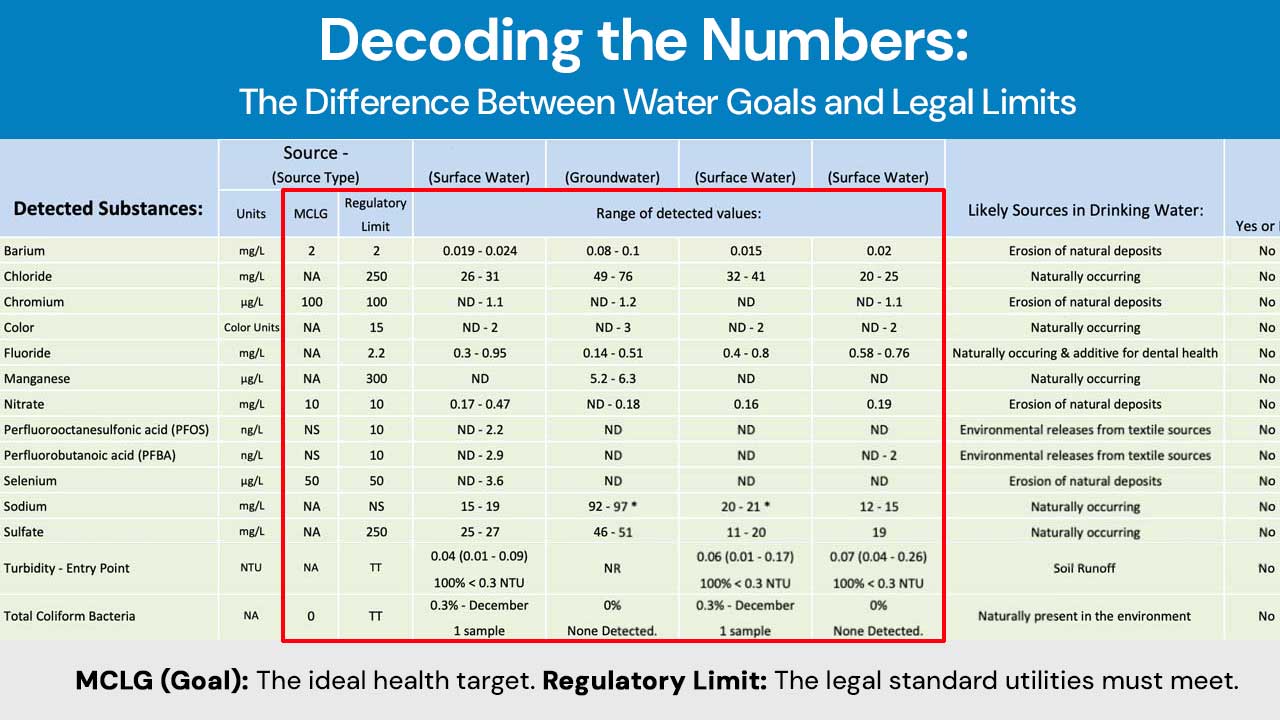
Maximum Contaminant Levels (MCLs) are enforceable legal limits. Water systems cannot exceed these levels. If they do, they must notify customers and take corrective action. The critical thing to understand is that MCLs have the complex job of balancing health protection with technical and economic feasibility. In other words, should you find yourself questioning certain choices, remember that MCLs go after what is achievable with current treatment technology at reasonable cost.
Maximum Contaminant Level Goals (MCLGs) are non-enforceable health-based targets. These represent the level at which no known or anticipated adverse health effects would occur, with an adequate margin of safety. MCLGs are often set at zero for known carcinogens, even though the enforceable MCL may be higher.
If you take just one thing from this article it should be this: Your water can meet legal standards (below the MCL) while still containing contaminants above the ideal health goal (the MCLG). For families with young children, elderly members, or individuals with compromised immune systems, the gap between "legal" and "ideal" may warrant additional filtration.
Municipal water treatment protects against acute microbiological contamination: making water safe from bacteria, viruses, and parasites that cause immediate illness. But "safe" doesn't mean "pure." Treatment itself creates trade-offs: chlorine disinfection produces byproducts, aging infrastructure introduces metals, and emerging contaminants often escape conventional treatment altogether.
How to Find and Read Your Water Quality Report
Finding your CCR is simpler than you might expect. Many utilities mail reports annually, but if you've moved recently or never received one, try these approaches:
Search online: "[Your city/county name] water quality report" or "[water utility name] consumer confidence report" typically returns current and archived reports.
Check your utility's website: Most water providers post CCRs prominently on their sites, often under "Water Quality" or "Reports" sections.
EPA's database: The EPA maintains links to CCRs at epa.gov/ccr, searchable by state and water system. Click on "Find Your Local CCR."
Call your utility: Customer service can mail or email your most recent report.
Once you have your report, focus on these key sections:
What to Look For in Your Consumer Confidence Report
Your CCR organizes contaminants into categories. Here's what matters most for home filtration decisions:
Disinfectants and Disinfection Byproducts (DBPs)
- Chlorine or chloramine: Your utility uses one of these to kill pathogens. Chlorine creates a distinct taste and odor many find unpleasant, while chloramine (chlorine plus ammonia) lasts longer in distribution systems but requires specialized filtration. Standard carbon filters remove chlorine effectively but need catalytic carbon to address chloramine. (Read more about How to Remove Chlorine and Chloramines from Drinking Water.)
- Trihalomethanes (THMs) and Haloacetic Acids (HAAs): These disinfection byproducts form when chlorine reacts with organic matter in water. Long-term exposure to elevated levels raises health concerns. Many homeowners choose to reduce these even when below MCLs, particularly for drinking and cooking water.
Heavy Metals
- Lead: No safe level exists for lead, especially for children. Lead typically enters water through home plumbing such as older pipes, solder, or fixtures. If your report shows any lead detection or your home was built before 1986, reverse osmosis filtration provides excellent reduction. But be aware that high levels may require additional filtration and mitigation.
- Copper, arsenic, chromium: These metals can leach from natural sources or industrial contamination. Elevated levels warrant attention, particularly for copper (which causes gastrointestinal distress in high concentrations) and arsenic (a known carcinogen even at low levels).
- Iron and manganese: You may know about these metal contaminants from the brown or black stains in your sinks or laundry. If you have hard water, you are more likely to have these metallic elements in your water. While iron is generally considered safe in low levels in water, manganese is usually best filtered from water. Be aware that there are different forms of iron in water requiring different filtration methods.
Emerging Contaminants
- PFAS (per- and polyfluoroalkyl substances): These "forever chemicals" don't break down naturally and accumulate in the body. The EPA recently established enforceable limits for several PFAS compounds, but testing and treatment vary widely by utility. Learn more about PFAS and filtration options.
- Microplastics: While not yet regulated, research increasingly shows microplastic presence in municipal water supplies. Reverse osmosis systems capture these tiny particles that conventional treatment misses.
Hardness and Minerals
- Calcium and magnesium: These minerals cause "hard water" that damages appliances, leaves residue, and affects taste. While not health hazards, many homeowners address hardness through whole house water filtration or dedicated softening systems. Learn more about your water softening and descaling options.
What Your Numbers Mean
Your CCR lists detected contaminants with their concentration ranges (how much was found), the MCL (legal limit), and the MCLG (health goal). Pay attention to:
- Anything detected above the MCLG, even if below the MCL
- Contaminants approaching or exceeding MCLs (violations requiring notification)
- Contaminants with health effects notes, particularly for vulnerable populations
- Year-over-year trends if you review multiple reports
Taking Action: Matching Filtration to Your Water Quality
Once you understand what's in your water, you can choose water filters and filtration systems that address your specific concerns. The good news: accessible, cost-effective solutions exist for most common issues.
Point-of-Use Solutions for Drinking Water
If your concerns center on what you drink and cook with, point-of-use filtration provides targeted protection:
Reverse osmosis systems excel at comprehensive contaminant reduction. These under-sink or countertop units remove 95–99% of dissolved solids, including:
- Heavy metals (lead, arsenic, chromium, copper)
- PFAS and emerging contaminants
- Microplastics
- Fluoride
- Nitrates
- Many disinfection byproducts
Modern tankless RO systems deliver filtered water on demand while wasting less water than traditional models. The upgrade to tankless is also super helpful for larger households and home cooks who use a lot of water in the kitchen.
Carbon filters (pitcher filters, faucet-mounted units, or under-sink cartridges) effectively reduce:
- Chlorine taste and odor
- Some disinfection byproducts
- Some volatile organic compounds (VOCs)
For chloramine removal, ensure your carbon filter uses catalytic carbon specifically designed for this disinfectant.
Whole-House Solutions for Comprehensive Treatment
When your water quality issues affect all uses (we're now talking showering, laundry, appliances, cooking, and drinking!) whole-house water filtration makes sense:
- Sediment filters remove flakes of rust, dirt, and particles that damage plumbing and clog up faucet aerators and appliances
- Carbon filters address chlorine, taste, and odor throughout your home and are often used as multiples in a sequence
- Water descaler softeners eliminate hardness minerals that cause scale buildup
- Multi-stage systems combine technologies to address complex water quality challenges
When to Call a Professional
While home filtration addresses most common issues, some situations require specialized treatment:
- Extremely high contaminant concentrations may overwhelm standard filters
- Bacterial contamination requires disinfection before filtration (typically only applies to homeowners with private wells)
- Some industrial contaminants need specialized media beyond typical consumer products (high levels of iron, for example, can quickly clog up your otherwise hard-working residential RO)
- Well water often requires comprehensive testing and custom treatment plans
The Bottom Line: Knowledge Empowers Action
Here's the deal: Your Consumer Confidence Report isn't regulatory overreach or mindless bureaucratic paperwork. It's your water quality roadmap. The word "confidence" is there for a reason: Municipal treatment processes protect you from acute illness. This is good. But additional layers of filtration can address the chronic low-level exposures that concern many families, especially those with young children or health vulnerabilities.
The gap between "safe enough" by regulatory standards and "as pure as possible" for peace of mind is where home filtration makes a difference. Whether you choose comprehensive reverse osmosis, targeted carbon filtration, or whole-house treatment, you're taking control of your family's water quality based on data, not guesswork.
Find your CCR. Read it. Understand what's flowing through your pipes. Then make the filtration decisions that align with your priorities and budget. That's consumer confidence in action.
FAQs on Understanding Your Consumer Confidence Report
What is a Consumer Confidence Report?
What's the difference between an MCL and an MCLG?
How do I find my water quality report?
What should I look for in my Consumer Confidence Report?
If my water meets legal limits, do I still need a water filter?
When should I contact a professional instead of relying on home filtration?
RELATED PRODUCTS

Whole House Filters
The most advanced residential whole house water filter on the market!
Shower in filtered water!

Reverse Osmosis Filters
Choose from Tankless RO, Traditional Tank RO Systems, Countertop RO, and more!
Enhanced RO Filters Most TDS!
Check Out Our Remineralization Options!

Refrigerator Water Filters
Full line of filters available, including Whirlpool, LG, Samsung, Kenmore, Frigidaire, and more!
Drink Purer, Healthier Water!
Super Value Packs Available