Deionized Water: The Science Behind Ultra-Pure DI Water Filtration and When to Use It
 Andrew
August 20, 2026
#aquarium
#carwash
#deionization
#deionizedwater
#diwaterfilter
#resin
Andrew
August 20, 2026
#aquarium
#carwash
#deionization
#deionizedwater
#diwaterfilter
#resin

- Deionization uses specialized resin beads to remove both positively and negatively charged ions from water, achieving near-zero total dissolved solids for ultra-pure H2O.
- DI systems work best as post-treatment after reverse osmosis, since using DI alone quickly exhausts expensive resin cartridges and increases operating costs.
- Mixed-bed DI cartridges combine both resin types in a single filter for maximum purification, while separate-bed systems offer higher flow rates and individual resin replacement.
- DI water is essential for industries like electronics manufacturing, pharmaceuticals, and reef aquariums where even trace minerals can cause costly damage or contamination.
- Color-changing resins eliminate guesswork by shifting from green to purple as they become exhausted, making maintenance timing more precise and user-friendly.
From Discovery to Industry Standard


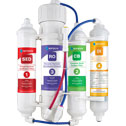
SpiroPure SP-RO400AQD 4-Stage Portable RO Water Filter with DI Filter for Aquariums

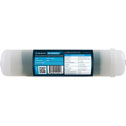
SpiroPure SP-ID200QC Deionizing DI Mixed-Bed Color-Changing Filter
Today's DI filter technology uses specially engineered resin beads that act like powerful magnets for dissolved minerals. These beads, typically made from a synthetic plastic polymer called polystyrene and the organic compound divinylbenzene, are designed with precise chemical properties that allow them to capture and hold onto specific types of ions. As water passes through these resins, positively charged ions (like calcium and magnesium) and negatively charged ions (like chloride and sulfate) are removed, leaving behind water that's virtually pure H2O.
How Deionization Works
Here's an example: When minerals dissolve in water, they naturally split into charged particles called ions. Take calcium, which is common in hard water. Calcium exists as a positively charged ion (Ca2+). The cation resin catches this calcium and releases hydrogen in its place. Similarly, when table salt dissolves in water, it splits into sodium and chloride, with chloride existing as a negatively charged ion (Cl-). The anion resin catches this chloride and releases hydroxide. The released hydrogen and hydroxide then join to form pure water: H2O.
Modern DI filter systems come in two main designs: mixed-bed, where both types of resin are combined in a single DI filter cartridge, and separate-bed, where each resin type has its own housing. Mixed-bed systems, typically using 40% cation to 60% anion ratio, can provide extremely high levels of purification and are ideal for applications requiring ultra-pure water in smaller volumes.
For home and light commercial applications, these filter cartridges are commonly available in sizes around 2.5" x 12", making them particularly convenient for use in combination RO DI water filter systems. While they can be used as standalone filters such as a DI water filter for a hose, this isn't recommended. Without pre-filtration like RO, the resin will quickly become exhausted from handling the full load of TDS, leading to frequent cartridge replacements and increased costs.
Separate-bed systems, while requiring more space, offer some advantages: they can handle higher flow rates, be optimized to certain high-TDS water, and allow for individual DI resin replacement when needed. This last point is particularly important for water with high CO2 levels, which can quickly exhaust anion resin while leaving cation resin still viable. In these situation, separate beds become more economical In other words, even following an RO, the lifespan and capacity (in terms of gallons) of a DI filter will vary widely based on input water chemistry and usage. Though it's reasonable to expect 300 to 1,000 gallons of use, measuring the output water quality itself is the best way to know when it's time to change a filter.
It's worth noting that while DI produces extremely pure water, it's not recommended for drinking. The process removes beneficial minerals along with contaminants, and unlike reverse osmosis and other water filters in a system, it doesn't filter out non-ionic substances like bacteria or particles and other types of contaminants. Instead, DI water finds its true value in applications where mineral-free water is essential.

Applications and Innovations in Deionization
Medical facilities and laboratories
In medical environments, even trace minerals can interfere with test results or react with sterilizing agents. DI water is crucial for laboratory testing where mineral content could skew results, medical device cleaning where mineral deposits could harbor bacteria, and surgical instrument sterilization where mineral scale could compromise sterility.
Aquariums
Deionization filters for aquariums is a common application of this technology. Owners of reef aquariums use DI filtration, typically as a final stage after reverse osmosis, to achieve precise water parameters. Even small variations in mineral content can affect coral growth and health, leading to costly losses of sensitive species or improper growth. A slight imbalance in minerals can also cause coral bleaching.
Automotive detailing
In professional car washing and detailing, minerals in water can leave spots and deposits that damage both the vehicle's appearance and the washing equipment. A deionized water system for car washes eliminates these issues by leaving no mineral residue behind, resulting in spot-free finishes and reduced damage to expensive equipment.

Electronics manufacturers are among the largest users of DI water filter systems. Modern electronics manufacturers require water that's completely free of minerals and other impurities. During the production of computer chips and circuit boards, even microscopic mineral deposits from regular water can create short circuits or interfere with the intricate pathways that make these devices work.
Pharmaceutical production
Pharmaceutical companies use DI water throughout their manufacturing processes. Any mineral content could react with medications, alter their effectiveness, or contaminate the final product. For injectable medications and vaccines, minerals in the water could cause serious adverse reactions in patients or compromise the stability of the formula.
Recent innovations have made DI systems more user-friendly and efficient. Color-changing resins like the SP-ID200QC shift from green to purple as they become exhausted.
This color change happens because of a special pH-sensitive dye incorporated into the resin beads — as the resin's ion exchange capacity depletes, the pH changes, triggering the color shift. Like the resin itself, this dye is safe for all standard DI applications and takes the guesswork out of maintenance timing, making it easier to know exactly when to replace the cartridge. Meanwhile, integration with RO systems has become seamless, allowing for complete water purification solutions that can handle everything from sediment to dissolved solids.
In Conclusion
Looking ahead, the demand for ultra-pure water continues to grow, driven by advances in electronics manufacturing, medical research, and industrial processes
As water quality standards become increasingly stringent, deionization technology remains at the forefront of water purification, providing the exceptional level of filtration that modern industries demand.
Whether you're maintaining a reef aquarium, operating a car wash, or running a medical facility, understanding deionization technology helps ensure you're using the right water filtration solution for your needs. While it may not be suitable for everyday drinking water, DI filtration plays an irreplaceable role in applications where absolutely pure water is essential.
FAQs on Deionized Water and RO DI Water Filter Systems
Is deionized water safe to drink?
What is the difference between deionized and distilled water?
What is a deionized water filter cartridge?
How do I know when to replace a DI filter cartridge?
What is deionized water?
RELATED PRODUCTS
SpiroPure SP-ID200QC Deionizing DI Mixed-Bed Color-Changing Filter
List Price: $23.20
Our Price: $11.60
Save: $11.60
SpiroPure SP-RO400AQD 4-Stage Portable RO Water Filter with DI Filter for Aquariums
List Price: $116.14
Our Price: $58.07
Save: $58.07
SpiroPure SP-RO-400R RO Membrane Filter Replacement 400 GPD
List Price: $45.82
Our Price: $22.91
Save: $22.91