Sediment Water Filtration and the Best Whole House Sediment Filter
 Andrew
June 18, 2026
#depthgradient
#melt-blown
#pleated
#sedimentfilters
#string-wound
#wholehome
#whole-house-filter
Andrew
June 18, 2026
#depthgradient
#melt-blown
#pleated
#sedimentfilters
#string-wound
#wholehome
#whole-house-filter

- Sediment filters protect downstream components by removing particles before they damage carbon filters, RO membranes, water softeners, and appliances
- Melt-blown polypropylene, pleated polyester, and string-wound filters all effectively remove sediment but the right choice depends on particle size distribution, flow requirements, and maintenance preferences
- Big Blue (4.5" diameter) filters provide significantly more surface area than slim (2.5") cartridges, maintaining flow rates with finer micron ratings and extending filter life
- Micron ratings from 0.5 to 50 microns address different usage, applications and water quality
What Are the Main Types of Sediment Filters?
Whether as whole house sediment filters or in industrial or point-of-use applications, sediment filter cartridges remove physical particles through mechanical filtration. The three primary types use different manufacturing processes that create distinct filtration characteristics.
Melt-blown polypropylene filtersMelt-blown filters create a dense matrix of spun polypropylene fibers. Water flows from the outside toward the center core, with larger particles trapped at the surface and progressively smaller particles captured deeper in the filter media. Some spun polypropylene sediment filters are thermally bonded into a rigid structure better suited for hot water applications.
Versatile melt-blown filters are best for:
- Municipal or well water filters with mixed particle sizes that benefits from depth filtration capturing varied sediment
- Whole-house point-of-entry systems protecting carbon tanks, water softeners, and appliances from sediment
- Extended filter life applications using grooved AP Series design with increased dirt-holding capacity
- Pre-filtration for RO systems where fine micron ratings (1-5μ) protect membranes from sediment damage
- Post-filtration like for tankless water heaters or commercial systems requiring PD Series thermally bonded construction
- Large-volume residential and commercial installations using DD Series 4.5" diameter for maximum surface area
Ideal applications: Pre-filtration for RO systems and whole-house point-of-entry filtration, protecting carbon tanks and water softeners
String-wound polypropylene filtersString-wound filters wrap polypropylene cord around a rigid center core with carefully controlled tension. The winding pattern and cord thickness determine the micron rating and dirt-holding capacity, with increasing density from surface to core.
String-wound filters are best for:
- Well water systems where visual assessment shows sediment accumulation between string layers without removing the filter
- Applications requiring larger capacity depth filtration that captures bigger particles at the surface and smaller particles toward the core
- Whole-house well water systems using WP Series 4.5" Big Blue diameter for maximum dirt-holding capacity
- Flexible micron rating needs with availability from 0.5 to 100 microns across both series
- Pre-filtration where controlled winding tension and cord thickness deliver precise micron ratings
Ideal applications: Well water systems, applications requiring visual filter assessment, pre-filtration where depth capacity matters
Pleated polyester filtersPleated filters fold polyester material into an accordion shape, dramatically increasing surface area compared to depth filters of the same diameter. This expanded surface captures sediment across the entire pleated material rather than through depth.
Pleated polyester filters are best for:
- Residential water pre-filtration where accordion pleating provides maximum surface area in standard housing sizes
- Cost-conscious applications where washable R Series and S1 Series filters can be rinsed and reused multiple times
- Systems requiring bacterial resistance from pure polyester or polypropylene construction
- Applications avoiding cellulose materials due to bacterial colonization and biofilm risks in untreated water
- Point-of-use filtration where compact size with high surface area maintains flow rates
Ideal applications: Pre-filtration at home, applications requiring washable filters, systems where surface filtration and flow rate are optimal
Important note for well water: Avoid cellulose-blend pleated filters from some manufacturers for well water applications. Cellulose supports bacterial colonization and biofilm formation. It can also disintegrate. Pure polyester or polypropylene pleated filters eliminate these risks.
Industrial and job site applications: Bag filters represent another sediment filter category designed for high-volume commercial and industrial water filtration. These filters handle heavy sediment loads in applications like car washes, manufacturing facilities, and construction sites. Read more in our liquid bag filters guide or browse our bag filter selection.
How Do Filter Size and Micron Rating Affect Performance?
Housing size and micron rating work together to determine filtration effectiveness and maintenance frequency.
Housing diameter matters
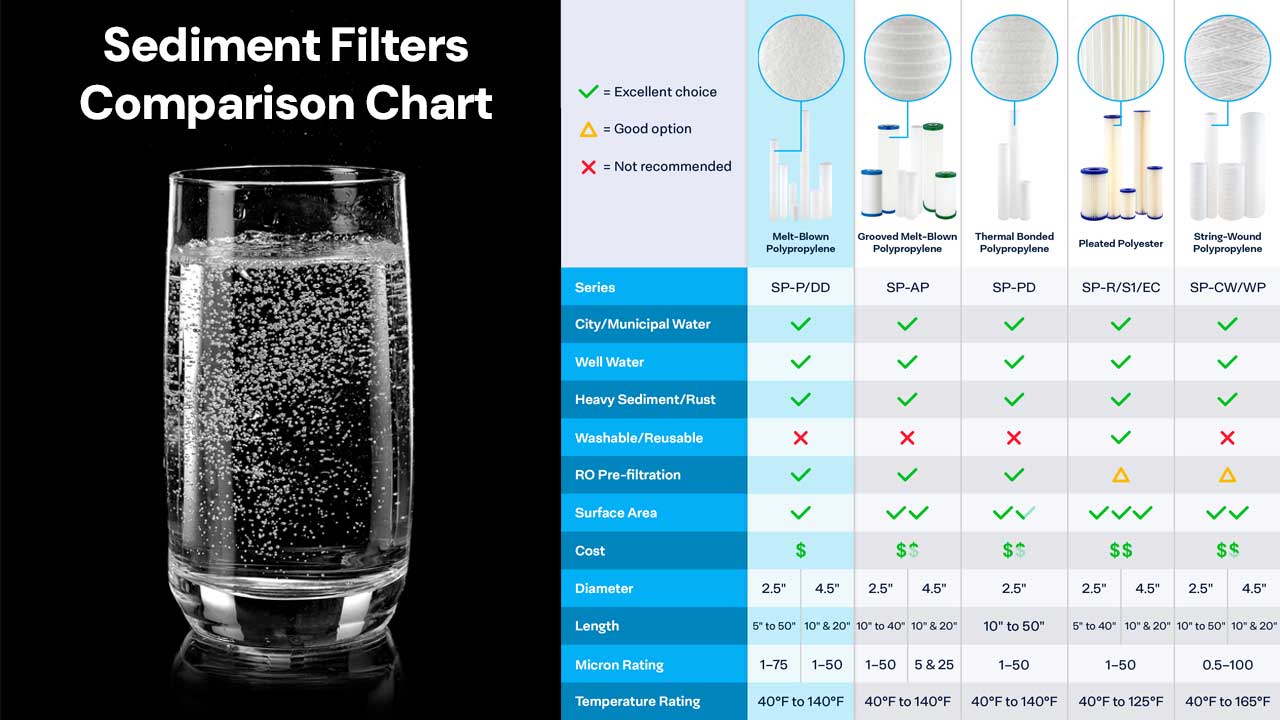
Slim housings (2.5" diameter) fit tight installation spaces and work well for point-of-use applications or lower-flow whole-house systems. Big Blue housings (4.5" diameter) provide approximately four times the surface area of slim cartridges. The same micron rating in a Big Blue format maintains higher flow rates and lasts significantly longer before replacement.
The performance difference becomes critical with finer microns. A 1-micron filter in slim format creates noticeable pressure drop in whole-house applications. That same 1-micron rating in Big Blue can maintain adequate flow while providing superior particle removal.
Cartridge length extends capacity
Standard residential filters come in 10-inch and 20-inch lengths, with 30-inch, 40-inch, and 50-inch options available for higher-capacity applications at job sites. Doubling the length doubles the surface area and extends service life proportionally if sediment load and distribution remains consistent.
Micron ratings match applications
Sediment filter micron ratings range from 0.5 to 100 microns, with each serving specific purposes:
- 0.5-1 micron: Fine sediment removal, RO pre-filtration, final-stage polishing
- 5 micron: Standard municipal water pre-filtration, carbon filter protection
- 10–20 micron: Well water with moderate sediment, first-stage filtration
- 30–100 micron: Heavy sediment loads, protecting downstream finer filters
Selecting the right micron rating prevents two common problems: too fine (higher micron ratings or the small numbers) creates rapid clogging and pressure drop, while too coarse (lower micron ratings or the bigger numbers) allows particles through that can damage downstream components.
Which Sediment Filter Should You Choose?
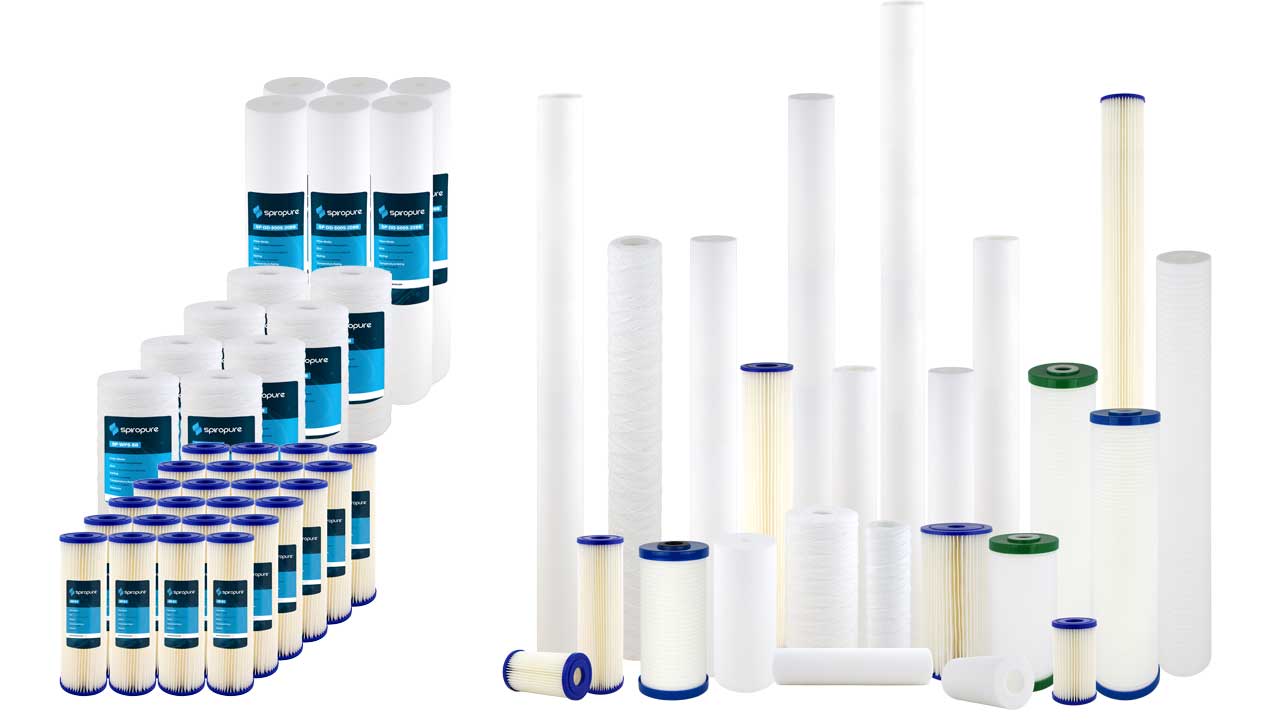
The overlap between sediment filter types means most applications have multiple viable options. Here's how to narrow the choice:
For well water systems, melt-blown or string-wound filters in Big Blue housings provide the dirt-holding capacity and flow rates needed. Dual-gradient SP-DD models offer larger-to-smaller filtration across the double depth of the filter. Wells with lower sediment load and lower flow households may get by with a single slim (2.5" diameter) model.
For municipal water pre-filtration, any type works well at around 5 microns. Pleated polyester filters offer washability that can extend service life. Melt-blown provides reliable depth filtration. String-wound gives visual filter loading assessment.
For RO system protection, 5 micron melt-blown or pleated filters in slim housings provide adequate sediment removal without excessive pressure drop. Some installers prefer 1 micron final-stage protection, particularly with well water sources.
For water dealers and plumbers, stocking 5 micron and 20 micron filters in both slim 10-inch and Big Blue 10-inch covers most residential replacement needs. Melt-blown P Series and AP Series provide reliable performance across applications while DD Series offers dual-gradient all-in-one depth filtration for challenging sediment loads.
For homeowners with no existing filtration unsure where to start, locate your Consumer Confidence Report from your water utility or get a current well water test. For many households, a simple two- or three- stage whole-house water system might be enough. (Learn more in our video below.) For more serious contamination, larger or specialized filtration systems may be necessary.
Sediment filtration isn't glamorous, but it's essential. There is a lot of overlap and some experimentation might be necessary to dial in the ideal filter for your water quality. Once there, the right filter type, housing size, and micron rating protects the money and time you've invested in downstream water treatment, from carbon filters and water softeners to RO systems and appliances. Match the filter to your sediment load, housing to your flow requirements, and micron rating to your protection needs.
RELATED PRODUCTS
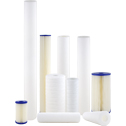
20x4.5 Sediment Filters
20x4.5 BB replacement sediment filter cartridges available in all types and micron ratings!
Get Clearer, Cleaner Water!
Save More with Case Packs
10x2.5 Sediment Filters
10x2.5 replacement sediment filter cartridges available in all types and micron ratings!
Get Clearer, Cleaner Water!
Save More with Case Packs
10x4.5 Sediment Filters
10x4.5 BB replacement sediment filter cartridges available in all types and micron ratings!
Get Clearer, Cleaner Water!
Save More with Case Packs