How Often Should You Replace Your Furnace Filter
 Andrew
April 14, 2026
#airfilters
#filterreplacement
#furnacefilters
#HVAC
#indoorairquality
Andrew
April 14, 2026
#airfilters
#filterreplacement
#furnacefilters
#HVAC
#indoorairquality
- Learn the baseline replacement schedule for different filter types and thicknesses
- Understand which household factors accelerate filter replacement frequency
- Recognize the warning signs that indicate your filter needs immediate replacement
Why Changing Your Furnace Filter is Important
Replacement frequency depends on filter type and thickness, household conditions, and air quality demands. Someone living alone part-time in a pet-free tiny home likely follows a different schedule than a large household with three dogs, two cats, a grandpa smoking his pipe in the den, and a family stricken with an array of environmental or seasonal allergies.
Whatever the household condition, a clogged furnace filter forces the blower motor to work harder to pull air through dense, particle-saturated media. Increased resistance reduces airflow throughout ductwork, which decreases heating and cooling efficiency and increases energy consumption. The Department of Energy estimates that replacing a dirty filter with a clean one can lower energy use by 5 to 15 percent. No one's laughing at your 12-pack of replacement filters now.
Beyond efficiency, filter replacement directly affects indoor air quality. As filters collect dust, pollen, pet dander, and mold spores (and not in the same way as Dr. Egon Spengler in Ghostbusters), their capture efficiency declines. Eventually, a saturated filter begins releasing trapped particles back into your air. For households with allergy sufferers, asthma patients, or young children, this decline in air quality can trigger respiratory symptoms.
Neglected filters also shorten HVAC equipment lifespan. Dust that bypasses a clogged filter accumulates on blower blades, heat exchanger surfaces, and evaporator coils. These contaminants reduce heat transfer efficiency, force components to operate outside their designed parameters, and eventually require expensive professional cleaning or premature equipment replacement. Regular filter changes represent the simplest and most cost-effective maintenance task for protecting your HVAC investment.
Factors That Affect Furnace Filter Replacement Frequency
Several factors influence how often you should replace your furnace filter. Understanding these variables helps you establish a maintenance schedule and find the best furnace filters to match your household's specific conditions:
- Filter thickness determines baseline replacement intervals. Standard 1-inch and 2-inch filters require replacement every 60 to 90 days under typical conditions. These thinner filters have less media surface area, which means they reach saturation faster than thicker alternatives. Thicker 4-inch and 5-inch filters last six months to a year because their expanded pleats provide dramatically more particle capture capacity before airflow restriction becomes problematic. A good shorthand for how often to change your furnace filter? 1" and 2" once per season/quarter or sooner. 4" and 5" whole-house filters once or twice a year.
- MERV rating affects how quickly filters clog. Higher-efficiency filters trap more particles per cubic foot of air processed, which means they accumulate contaminants faster than lower-rated options. A MERV 13 filter in identical conditions can require more frequent replacement than a MERV 8 filter because its denser media captures fine particles that pass through lower-rated alternatives. For detailed information on MERV performance characteristics, see our complete MERV guide.
- Household occupancy and activity levels directly impact replacement frequency. Homes with multiple occupants generate more airborne particles from daily activities. Cooking, cleaning, foot traffic, smoking, and other activities all contribute contaminants that filters must capture. Similarly, homes in dusty climates or near unpaved roads, major thoroughfares, industry, and that guy who burns trash all experience faster filter saturation than those in areas with stable air quality.
- Pet ownership accelerates filter replacement dramatically. Dogs and cats shed fur and dander continuously, with peak shedding during seasonal coat changes. Homes with one or two pets should replace 1-inch filters every 30 to 60 days rather than the standard 60 to 90 days. Homes fostering a competitive long-distance sled dog team's quantity of furbabies may be replacing monthly or more to maintain adequate airflow and air quality. You might also consider a central vacuum or kenneling in an outbuilding. For specific guidance on furnace filters for pet owners, consider MERV 11 to MERV 13 ratings that capture fine pet dander effectively.
- Allergy and respiratory sensitivities create additional replacement considerations. Households with asthma sufferers or severe allergy patients benefit from more frequent filter changes during high-pollen seasons. Spring and fall typically demand 30 to 45-day replacement intervals even with thicker filters, as outdoor pollen counts overwhelm filter capacity more quickly than standard household dust.
Signs You Need to Replace Your Furnace Filter
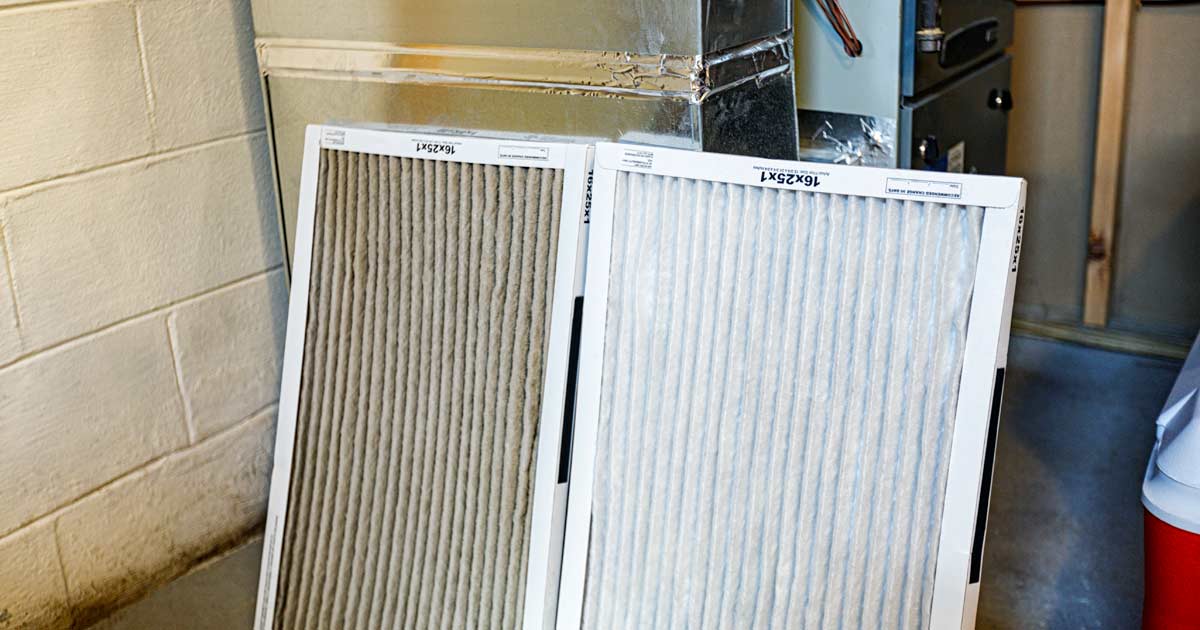
Visual inspection provides the most reliable indicator of filter condition. Remove your filter monthly and hold it up to a light source. If light passes through easily and you can see the individual pleats or fibers clearly, the filter still has useful life remaining. If the filter appears uniformly gray or brown and blocks light, it sounds like it's time to move on.
Reduced airflow from vents is another sign. If rooms feel stuffy or individual vents deliver noticeably weaker airflow than usual, check your filter. A clogged filter creates back-pressure that reduces air circulation throughout your ductwork.
Increased dust accumulation on furniture and surfaces could indicate your filter has reached saturation. It might also mean Pig-Pen from the Peanuts stopped by for an Arnold Palmer. But when you notice dust settling more quickly than normal or find yourself cleaning more frequently, you might have a dirty filter.
Unusual furnace cycling behavior such as short bursts of operation followed by shutdowns could be from severely restricted airflow caused by clogged filters. Modern furnaces include safety switches that shut down the system when airflow drops below safe thresholds. If your furnace starts and stops repeatedly without reaching target temperature, check the filter before assuming equipment failure. This may sound basic, but technicians tell us they've made costly service calls only to find a filter unchanged since the Clinton administration.
Need Installation Help?
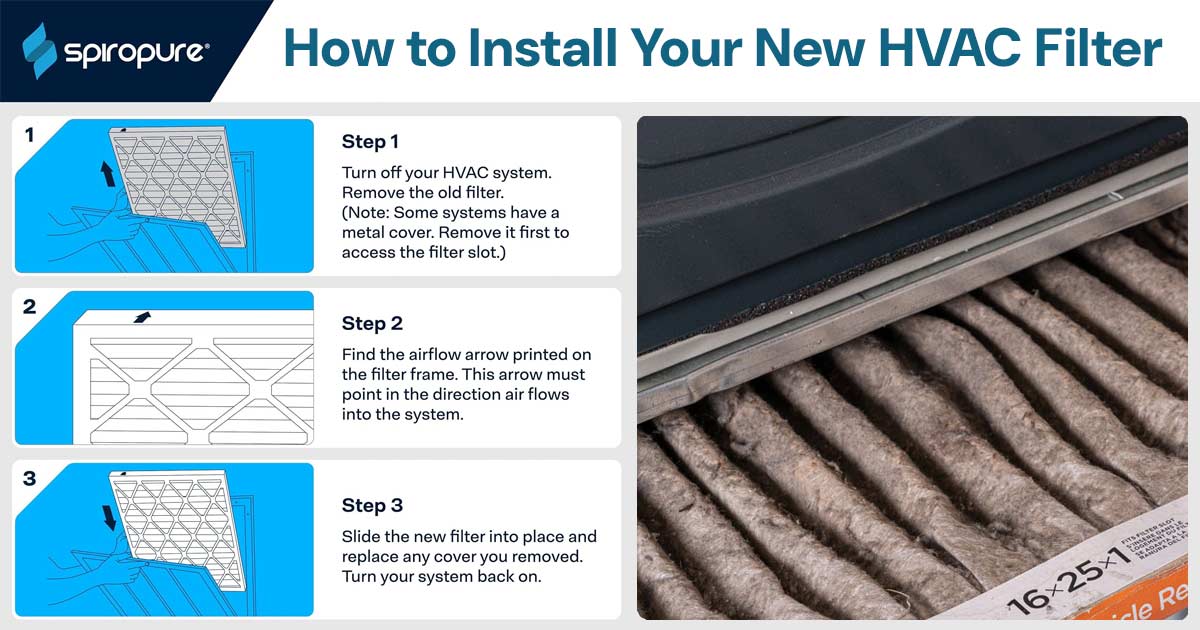
Now that you understand replacement frequency, if you have questions about the installation process itself, see our furnace filter installation guide for step-by-step instructions.
FAQs on How Often Should You Replace Your Furnace Filter
How do I know when to change my furnace filter?
How often should you change your furnace filter in a rental home?
What happens if you don't change your furnace filter regularly?
How long can you go without changing your furnace filter?
How often do you need to change the furnace filter in the winter?
RELATED PRODUCTS
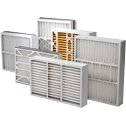
AC & Furnace Filters
Residential and commercial air filters for air conditioning, geothermal, furnaces, and more!
Breathe Better in Your Home!
Save BIG on Case Packs

4" AC & Furnace Air Filters
Find 4" thick air filters in standard and custom sizes for your home HVAC or furnace system!
Breathe fresher, cleaner air at home!
BIG Savings with Case Packs!

1" AC & Furnace Air Filters
Standard and custom sizes to get the right fit for your HVAC or furnace system.
Cleaner, fresher air in your home!
Free Shipping & MORE savings with Case Packs!