How To Test Your Indoor Air Quality: Tips, Kits & Costs
 Andrew
September 16, 2026
#airfilters
#airpurifiers
#carbonmonoxide
#humidity
#iaq
#indoorairquality
#PM2.5
#radon
#VOCs
Andrew
September 16, 2026
#airfilters
#airpurifiers
#carbonmonoxide
#humidity
#iaq
#indoorairquality
#PM2.5
#radon
#VOCs
- Testing options range from free/cheap DIY kits and monitors to professional assessments costing $300–$1,000.
- Plan to test for radon, CO, PM2.5, humidity, and VOCs separately because no single tool catches every pollutant
- Radon and carbon monoxide require dedicated detectors and HVAC filters don't help with either issue
- Regular MERV 8–13 filter replacement is your baseline defense against everyday particulates.
What Should You Test for in Your Home's Air?
What to test for in your home's air is entirely up to you. As with everything in home ownership, you have a wide range of options at your disposal and the choices can be overwhelming. You don't want to miss anything, but you may not have the budget to test for everything. Common air quality issues include everything from everyday dust, dander, and lint, to familiar challenges such as humidity and pollen, to more serious concerns like PM2.5, mold, VOCs, carbon monoxide, and radon.
| Pollutant | Common Source | Testing Method |
|---|---|---|
| PM2.5 / dust | Everyday activity, outdoor infiltration | IAQ monitor |
| Pollen, pet dander | Outdoors, pets | IAQ monitor, visual/symptom check |
| Mold | Excess moisture and leaks | Visual inspection, mold test kit, professional testing |
| VOCs | Paint, cleaners, new furniture | VOC test kit or IAQ monitor |
| Carbon monoxide | Gas appliances, vehicles | Dedicated CO detector(s) |
| Radon | Soil gas, foundation cracks | DIY radon kit or professional testing |
How to Test Indoor Air Quality in Your Home
We mentioned all-in-one monitors earlier and there are a few popular models. But they should not be understood as the entire story. Still, relatively inexpensive products made by brands like IKEA as well as premium certified products can be used to test for particulates such as fine dust and smoke, volatile organic compounds (VOCs), temperature, and carbon dioxide, and comfort factors like humidity that is also a primary influence in the formation of mold. But life-threatening contaminants like carbon monoxide require specialized monitoring tools. To help you better understand the options, here are six major air pollutants and how to test for them.
Use an Indoor Air Quality Monitor
Various brands of spot-check meters and ongoing monitoring devices cover PM2.5, VOCs, CO2, humidity, temperature tracking and more. The handheld tools are useful for pinpointing potential sources of air contamination such as off-gassing paints and varnishes or other components in renovation or new construction. The continuous monitors are best placed in main living areas and near bedrooms, away from windows, doors, HVAC vents, air purifiers, and the kitchen, which can lead to false readings. Carbon monoxide monitors perform at breathing height while smoke alarms are placed high upon walls or ceilings. Radon monitors are usually in the basement or crawl space, which is also a good place to watch humidity.
Install Carbon Monoxide Detectors
Carbon monoxide has a reputation for being a silent killer for good reason: it's invisible, odorless, and tasteless, and can come from regular household gas appliances, vehicles, and other sources, whether properly functioning or malfunctioning. Fortunately, there are dedicated carbon monoxide detectors that can warn homeowners about leaks, including code-mandatory standard alarms to help prevent fatalities or more expensive low-level CO monitors to reduce long-term health issues.
Test Your Home for Radon
Homeowners most commonly encounter radon tests when purchasing a home as part of the inspection process. This soil gas commonly enters through basements and crawlspaces, then migrates into living areas above. Long-term exposure can cause respiratory damage, including lung cancer that develops gradually over time. There are both short-term tests and continuous monitoring devices, and confirmed elevated levels can be paired with mitigation measures combining PVC pipes and fans to vent radon safely outside. See the EPA's radon guidance for action levels and next steps.
Check Indoor Humidity and Signs of Mold
Far from the arid high-country deserts of the American southwest, humidity can lead to indoor air quality problems as moisture and mildew accumulate and create a breeding ground for mold spores to feed on organic materials. Musty, earthy smells accompany visible accumulation of colonies in various shades and textures, not just black. While expensive moisture sealing steps can be taken, some homeowners opt for dehumidifiers running to pull moisture from the air and keep relative humidity below 60%, ideally in the 30% to 50% range.
Use Test Kits for Specific Pollutants
There may be additional indoor air quality issues not addressed in this article, and that’s likely because they are specialized issues requiring dedicated test kits. Professionals or DIY homeowners can purchase kits to mail into laboratories for increased accuracy. These tests work well on VOCs like formaldehyde exposure levels or pinpointing unknown chemical odors.
Schedule Professional Indoor Air Quality Testing
If the DIY route isn’t appealing or you’re struggling with persistent odors, hidden mold, major water damage, conflicting readings you can’t interpret, or multiple suspected sources, it might be time to call in a pro. Certified Indoor Environmentalists focused on indoor air quality can provide a range of services from standard IAQ to comprehensive testing costing anywhere from a few hundred dollars to over a thousand. The International Association of Certified Indoor Air Consultants is a good place to start. Generic HVAC contractors are often not set up for this level of testing.
When Should You Test the Air Quality in Your House?
You don't need to wait for a scheduled test. Consider testing if you notice, experience, or in the middle of any of the following:
- Recent renovations, painting, or new furniture to rule out short-term problems
- Water damage or a past leak
- Wildfire smoke or persistent pollution in your area
- A malfunctioning furnace or gas appliance
- Persistent musty, sour, or other unusual odors
- Unusual dust buildup
DIY Home Air Quality Testing vs. Professional Testing
The right approach depends on your budget, symptoms, and how deep you need to go:
- DIY monitors and test kits: lower cost, faster results, good for ongoing screening
- Professional testing: higher cost, calibrated equipment, pinpoints sources and offers remediation guidance
- Choose professional testing if DIY results are inconclusive, symptoms persist, or you're planning major remediation
How to Understand Your Home Air Quality Test Results
A single reading in isolation might not tell you much. While useful for pinpointing issues related to point-sources like off-gassing paints, long-term air quality issues might fluctuate over time. Instead:
- Track trends over several days rather than one reading
- Compare results across different rooms
- Compare morning, afternoon, and evening readings
- Re-test after any ventilation or filtration changes to measure improvement
How HVAC Filters Help Improve Indoor Air Quality
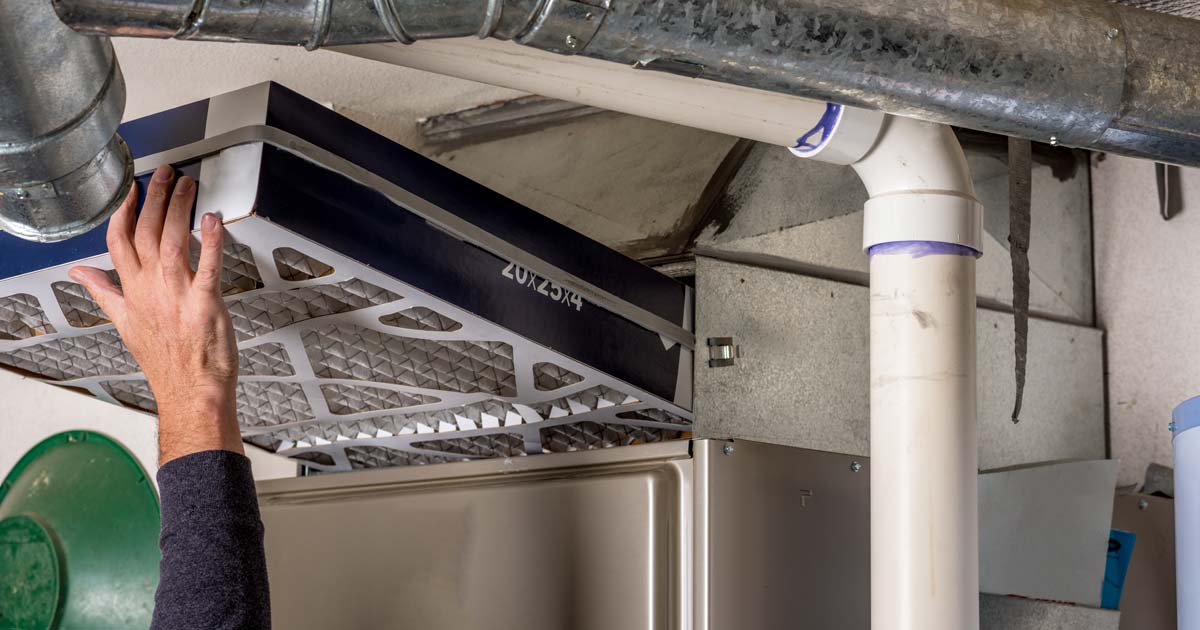
While specialized detectors handle threats like radon and carbon monoxide, your HVAC system is your first line of defense against everyday airborne particles. A properly sized MERV 8–13 AC and furnace filter captures dust, pollen, pet dander, and mold spores as air circulates through your home. Fit matters as much as filtration! An incorrectly sized filter leaves gaps for unfiltered air to bypass the media entirely. Replace 1" and 2" filters every two to three months (more often with pets or during high-pollen seasons). "Whole-house" 4" and 5" filters can last 6 months to a year. Before upgrading MERV/FPR/MPR rating, confirm your system can handle the added airflow resistance. While the larger numbers are appealing for the contaminants they can catch, older systems may not be able to function properly using them.
What MERV Rating Is Best for Indoor Air Quality?
MERV 8 handles everyday dust and pollen. MERV 11 adds increased efficiency for catching more pet dander and mold spores. And MERV 13 adds smoke and fine-particle protection. For the full comparison, see our guide on HVAC filters as your first line of defense for everyday air quality.